Category: Destinations

  • The Places That Charge You for Knowing They Exist

    The Places That Charge You for Knowing They Exist

    Málaga to Marrakech is about 300 kilometres. You could drive it, if you didn't mind the Strait of Gibraltar. They sit so close on the map that if you fell asleep over Spain and woke up in Morocco you'd barely have missed anything. The fuel burn on both flights is almost identical. And yet Málaga will typically cost you three times the price of Marrakech. Sometimes more.

    That gap isn't geography. It's a set of decisions made by people you'll never meet, about places you've already decided you want to go.
    Tourist destination entrance fee sign — detail

    Why are flights to popular destinations more expensive?

    Airlines don't price by distance. They price by competition, and by what they've learned the market will quietly absorb. Málaga has fifteen carriers fighting over the same slots for four months of the year. Marrakech has fewer. The counterintuitive result? The route everyone knows about – the one with the brochures and the hen parties and the matching luggage – is the expensive one. Not because it costs more to fly there, but because enough people will pay whatever it costs.

    And that premium doesn't stop at the departure gate. It travels the whole way with you.

    The Invisible Queue of People Taking a Cut

    Every popular destination has a chain assembled behind the scenes, and every link in it has its rate card. The handling agent who turns the plane around at the airport charges a fee per passenger. The hotels pay commission to the big booking platforms – somewhere between 15 and 25 per cent on most rooms, sometimes higher – and then adjust their rack rates upward to cover it. The taxi rank outside arrivals in a well-trodden resort is frequently an informal cartel with agreed minimum fares. The restaurant with the prime seafront table has worked out precisely what a sunburned British family will spend without flinching.

    None of these people are villains. They've just done the maths that familiarity makes possible.

    Why "Adventurous" Is Often a Discount

    A destination becomes expensive not when it becomes beautiful, but when it becomes known. The economics only assemble themselves once there's reliable, predictable demand to feed. Which means somewhere genuinely unfamiliar – a secondary city, a country that hasn't yet appeared on the front of a Sunday supplement, a route that only one airline operates on Tuesday and Thursday – is often cheaper not despite being unfamiliar, but precisely because of it. The chain hasn't had time to form. The hotel still wants your booking. The taxi driver is still negotiating.

    Travellers who end up somewhere like Plovdiv, or Porto before Porto became Porto, or Tbilisi on a whim often report the same mild bewilderment: this was inexplicably cheap. It wasn't inexplicable. It was just unfamiliar enough that nobody had got around to pricing in the fact that they'd pay more.

    The Map You're Really Reading

    When you search for flights and feel the pull of the obvious destination, what you're really looking at is a map of other people's confidence. The expensive places are expensive because millions of people before you decided they were worth it, and the whole industry recalibrated accordingly. The cheap places are the ones where that consensus hasn't formed yet – they might be just as good, occasionally better. They've just not been priced for certainty.

    Questions this raises

    • How do airlines actually set ticket prices?
    • Does booking earlier really get you a cheaper fare?
    • Which cheap airports sit near expensive ones?
  • The Place That Lands Before You See It

    The Place That Lands Before You See It

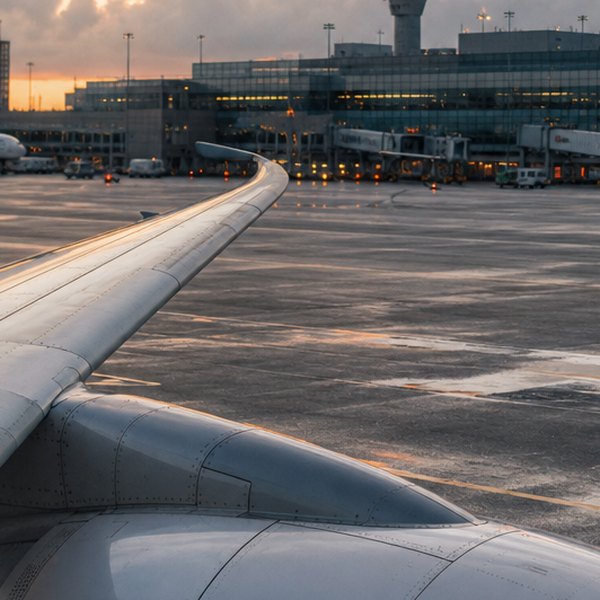
    Close your eyes on any flight and you can test this yourself. The moment the doors open – before the taxi queue, before the luggage belt, before you've clocked a single street sign – the place has already announced itself. Not visually. Through the nose and through the ears. Within a second or two, your brain has already run a kind of rapid-fire atmospheric scan and decided: yes, this is somewhere different.

    That is not romance. It is biology doing something genuinely useful.

    Misty landscape with distant ground emerging from clouds — detail

    How does a smell trigger a holiday memory years later?

    Smell bypasses most of the brain's polite filtering and goes straight to the hippocampus, which is also where memory is formed and stored. Sound is close behind. Sight, oddly, is the sense we trust most consciously – but it's the one that encodes place least durably. Ask someone to describe a city they visited fifteen years ago and they will almost certainly reach first for a smell or a sound. Diesel and hot pavement. A particular frequency of traffic. The way voices bounced off a certain kind of stone.

    There is a reason for that. Smell and sound are the senses that required your ancestors to act fast, encoding location urgently and early. Which is why a single whiff of sunscreen on cold air can reconstruct an entire holiday from two decades ago in about a fifth of a second flat.

    What Actually Produces the Signature

    The atmospheric identity of a place is not conjured from thin air. It is the measurable output of specific physical ingredients. Soil chemistry varies enormously – the bacteria and fungi in warm red earth are genuinely different from those in chalk downland or volcanic soil, and they off-gas accordingly. Building materials matter too: limestone holds and releases heat differently from concrete, and that thermal rhythm changes what you smell. Cooking fats and fuel sources layer in on top. For a piece on how technical information gets quietly encoded into everyday materials, The Tiny Technical Manual Sewn Into Your Clothes touches on something adjacent – the idea that objects carry more data in them than they appear to.

    Then there is the acoustic texture, which is mostly a function of density. Narrow medieval streets bounce sound back sharply, wide boulevards absorb it, water amplifies certain frequencies and kills others. When you say a canal city feels different from a landlocked one, you are partly picking up on genuine measurable differences in how ambient sound travels at 40% humidity versus 70%.

    The Thing You Never Quite Notice Noticing

    What this means practically is that the destinations you remember most vividly are not always the most spectacular ones. They are the ones with the most distinctive sensory fingerprint. Iceland is easier to remember than somewhere generically warm because volcanic sulphur, cold clean air, and near-total acoustic silence produce a combination that appears almost nowhere else on earth.

    Worth bearing in mind the next time you're choosing somewhere to go. The question is less "what is there to see?" and more "what will this place actually smell and sound like?" Because that is the version of it that will last.

    Questions this raises

    • Why do airports in different countries smell different?
    • Can you record the sound of a place usefully?
    • Does jet lag change how strongly you smell things?
  • The Holiday Britain Didn’t Invent

    The Holiday Britain Didn’t Invent

    Every summer, millions of British people pile onto charter flights to the same stretch of Spanish coast, clutch their all-inclusive wristbands, and assume, in some vague way, that this is all very British. The warm beer on the terrace, the full English by the pool, the rep in her polo shirt standing by a whiteboard – it feels like something Britain cooked up for itself. It wasn't, really. The whole apparatus was built, in large part, by people who came here fleeing Europe and then spent the next decade selling it back to us.

    The Man Who First Flew You to the Med

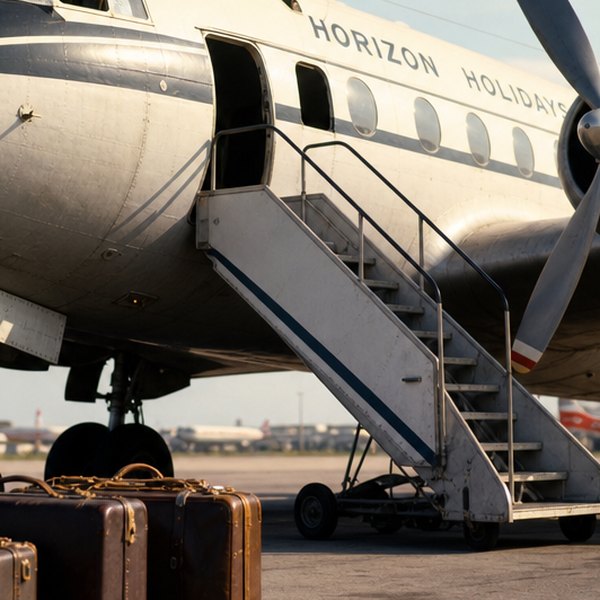
    Vladimir Raitz arrived in Britain as a Russian-born émigré and in 1950 launched Horizon Holidays. He chartered an old Vickers Viking aircraft and flew a small group of passengers to Corsica for a fixed price that included flights, tents, and meals. This was genuinely new. Ordinary working British people had never been able to afford to cross the Channel for a holiday – foreign travel was for the wealthy and the adventurous. Raitz had practical knowledge of the continent that most British people simply didn't have: its geography, its hospitality, its ferry connections, its hotels. All of it learned under circumstances rather more urgent than tourism.

    British celebration of non-British holiday tradition — detail

    People Who Already Knew the Map

    The postwar package holiday boom drew heavily on a generation of central European Jewish refugees who had fled to Britain in the 1930s. They arrived already multilingual, already familiar with how a continental hotel operated, already knowing which routes connected which cities. When British people were still regarding abroad as something vaguely treacherous, these were people for whom abroad had been home. For whom crossing borders was a skill learned out of necessity rather than curiosity.

    The Lunn travel business – which eventually became Lunn Poly, the high street chain that defined the British holiday shop for a generation – had its own roots in exactly this kind of continental knowledge and connection. Several of the founding figures of the postwar tour operator industry were men and women who arrived in Britain with almost nothing and remade themselves using the one asset no one could take away: they already knew Europe.

    The Rep in Her Polo Shirt

    What they built was remarkable not just as a business, but as a cultural transplant. The resort representative, the transfer coach, the half-board arrangement, the single-price holiday – all of it required a working infrastructure of relationships across European hotels, airlines, and local suppliers. You couldn't build that from a desk in London without contacts on the ground. But if you'd spent years working those same networks under far grimmer circumstances, you could.

    Britain didn't really invent the package holiday. It just turned up, wallet in hand, and found that someone had already built the whole thing and was ready to take the booking.

    Questions this raises

    • When did the first package holiday to Spain actually run?
    • Why were early charter flights cheaper than scheduled ones?
    • How did Horizon Holidays get round the flight regulations?
    • What happened to Britain's first package holiday firms?
  • The Price Tag That Keeps Moving While You’re Not Looking

    The Price Tag That Keeps Moving While You’re Not Looking

    You've done everything right. You cleared your cookies, you opened an incognito window, you waited until Tuesday. You've read all the articles. And then you check the fare again and it's gone up anyway. Something is clearly going on, and it isn't magic, and it isn't personal. It's yield management – a system invented in the 1970s specifically to make sure a plane never lands with an empty seat, and it has quietly eaten the entire travel industry since.

    The Man Whose Job Is to Never Fill the Plane at the Wrong Price

    Price tag with changing numbers on display — detail

    American Airlines gets the credit for formalising it, sometime around 1978. US deregulation meant carriers were suddenly competing on price, and an empty seat became money literally flying away. The answer was a revenue manager – a person, and now an entire department – whose sole job is to price each seat dynamically, based on how far out the flight is, how many seats remain, where demand is coming from and what competitors are charging. A seat sold too cheaply two months before departure leaves money on the table. A seat unsold at take-off is just lost. The whole game is threading the needle between those two disasters, one passenger at a time.

    This is why two people sitting next to each other on the same flight to Malaga can have paid wildly different amounts. Nobody has been cheated. The system worked exactly as designed.

    The Invisible Cut in the Middle

    Book through an online travel agent and another hand reaches into the transaction. The OTA takes a margin – typically somewhere in the region of ten to twenty per cent depending on the deal struck – and that cost is usually folded invisibly into the price you see. The airline or hotel has agreed to it because the OTA brings volume. You've agreed to it because you didn't know it was there, and honestly the comparison tool was very convenient.

    For an illustration of where all this gets genuinely strange, The Holiday That Died on a Typo is worth five minutes. A typo fare is really a yield management system briefly short-circuiting. The price logic breaks down, a human error slips through, and for a few beautiful hours the internet goes feral with £38 flights to Tokyo. Airlines sometimes honour them. Sometimes they don't. What makes it interesting is that the "correct" price was never really a fixed thing to begin with.

    The Room Is Almost the Cheap Part

    Hotels have run the same logic for years – RevPAR (revenue per available room) is the metric, and the room rate is only part of it. The spa, the minibar, the resort fee, the parking: a well-run hotel makes a significant slice of its margin from guests after they've already checked in. Which means the room rate is sometimes almost the loss-leader that gets you through the door.

    So when a hotel price looks suspiciously good, it might be. Or the room genuinely is cheap, because whoever set the rate that morning decided you were the right kind of guest to fill a Tuesday night they were worried about. Either way, someone has run the numbers, and it wasn't you.

    Questions this raises

    • Does clearing cookies actually change the flight price?
    • When is the cheapest time to book a flight?
    • How does an airline decide when to raise a fare?
    • Is dynamic pricing regulated in the UK?