Category: Clothing

  • The Tiny Technical Manual Sewn Into Your Clothes

    The Tiny Technical Manual Sewn Into Your Clothes

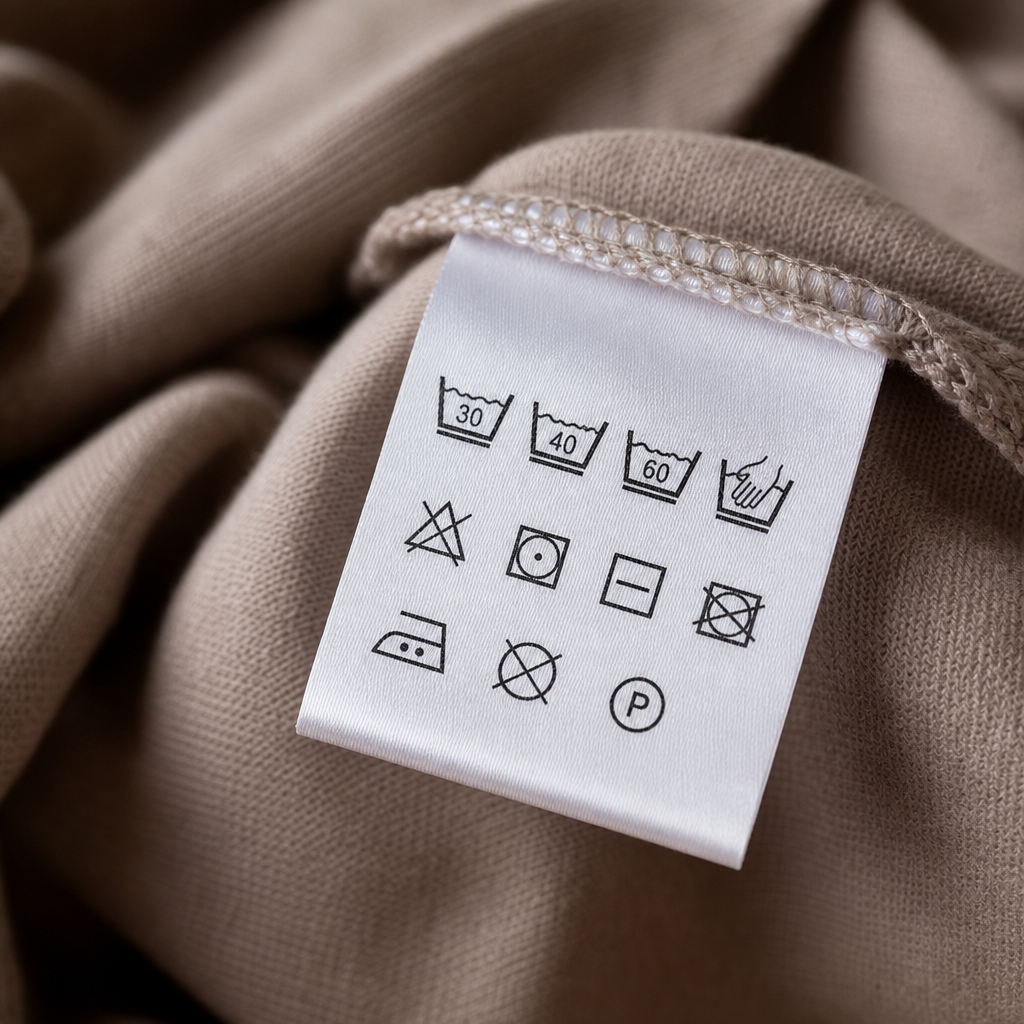
    Every piece of clothing you own is carrying a small document written in a language you were never taught. It's stitched into the side seam or the back neck, it scratches against your skin on warm days, and you have almost certainly ignored it your whole life. Which is a shame, because it's actually trying to tell you something quite specific.

    Those symbols were standardised by an international body called GINETEX – the French acronym, naturally, because of course it is – and in the UK they carry legal weight. Manufacturers are required to include them. And yet nobody hands you the key.
    Small instruction label sewn into fabric — detail

    The Tub (And What "Gentle" Really Means)

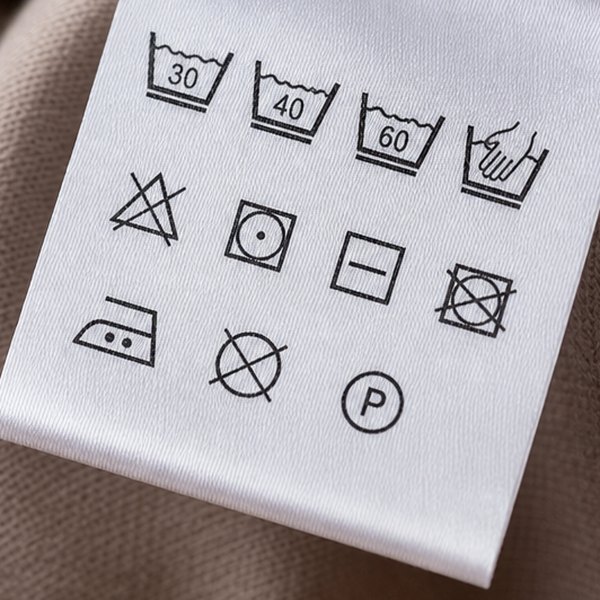
    The washing tub is the one most people squint at. A plain tub means machine wash. A number inside tells you the maximum water temperature in Celsius – not a rough guide, but actual agreed thresholds set by textile chemists. Thirty degrees, forty, sixty. A single line underneath the tub means a gentle cycle. Two lines means something even more reduced in agitation. No lines? Go for it.

    The hand in the tub is the one people tend to misread as "wash this softly and vaguely." It doesn't mean that. It means the garment cannot tolerate mechanical agitation at all – the drum rotating, the clothes tumbling against each other. That specific physical action is what damages the fibre, not the water, not the temperature. Handwashing keeps the fabric moving through water rather than against itself. There's a difference, and the symbol is trying to tell you exactly that.

    The Triangle That Isn't About Bleach (Except When It Is)

    A plain triangle means you can use any bleach. A triangle with two diagonal lines through it means chlorine-based bleach only – non-chlorine alternatives are fine. A completely crossed-out triangle means no bleach of any kind.

    The reason the chlorine one matters chemically is brutal. Chlorine bleach (sodium hypochlorite) doesn't just lift colour: it breaks the peptide bonds in protein fibres like wool and silk at a molecular level, essentially dissolving the structure of the fibre over time rather than simply staining or fading it. That's why your grandmother's woolly jumper didn't survive the "just a small splash" incident.

    Why do the dots inside the iron symbol matter?

    One dot: 110°C, safe for synthetic fibres like acrylic and nylon. Two dots: 150°C, for wool, polyester blends. Three dots: 200°C, for cotton and linen. These aren't conservative suggestions – they're the temperatures at which different fibre types begin to deform or scorch. Synthetics will actually melt at cotton settings, which produces a shiny, slightly tragic patch that no amount of re-washing will fix.

    The crossed-out iron is simple enough: the fibre cannot take direct dry heat, full stop.

    What does the circle symbol on a care label mean?

    A circle means dry clean. A letter inside it (P, F, W) tells the dry cleaner which solvent is safe to use on that specific fabric. You don't need to memorise those – that one really is for the professionals.

    But the rest of it? That tiny scratchy label is a surprisingly complete set of instructions, written in good faith by people who knew exactly what they were talking about. Worth a second glance next time it's irritating you.

    Questions this raises

    • Are care labels legally required in the UK?
    • Can you wash something hotter than the label says?
  • The Shop That Sold You a Number

    The Shop That Sold You a Number

    Before there were sizes, there was Sid.

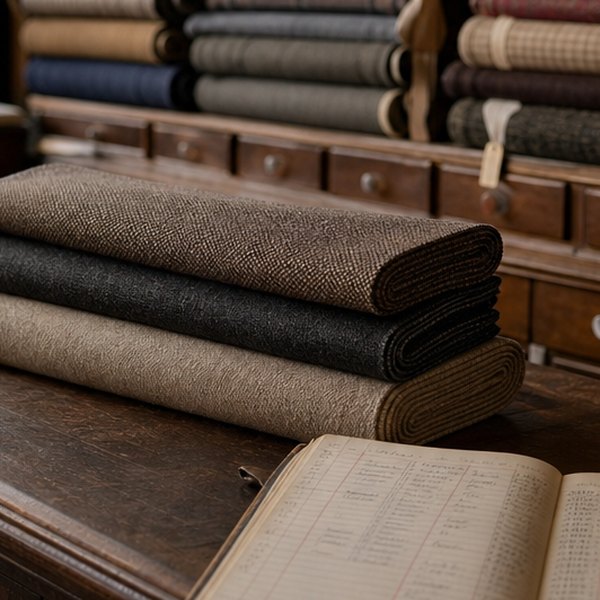
    Or whatever your local draper was called. Every high street had one, often two or three, and for most of the nineteenth and early twentieth centuries they were as essential as the baker or the butcher. You went in, you pointed at bolts of fabric stacked floor to ceiling – wool serge, cotton drill, a bit of flannel if you were feeling flush – and Sid or someone like him cut you a length. You took it home, or a seamstress came to you, or your mother ran it up on a treadle machine, and a few days later you had a coat. It fitted you because it was made around you.

    Shop counter with numbered tickets displayed — detail

    The draper was also, quietly, a banking system. Many ran informal weekly credit arrangements – you took the cloth home and paid it off over a month or two. No interest rate discussion, no credit check, just a ledger and the understanding that you'd be back. Families relied on this for school uniforms, work clothes, Sunday best. The draper knew everyone's measurements. Often they knew everyone's circumstances too.

    When did ready-made clothing replace made-to-measure?

    The phrase "off the peg" dates back to the mid-1800s, when the first pre-made garments – usually men's work clothes – were literally hung on pegs in shop doorways. But it was a novelty. A convenience item for emergencies, not how most people clothed themselves. That remained true well into the 1940s.

    What changed it was the Second World War, specifically the production infrastructure built to clothe entire armies. Manufacturers had spent years cutting fabric to standardised templates for millions of soldiers and, when the war ended, they had the machinery, the skills and the factories to do the same thing for civilians. The question was just: which civilians, and in what shape?

    The Fiction Everyone Agreed to Accept

    Here is the slightly uncomfortable truth about your size. It is not a measurement. A size 14 dress has no fixed dimensions – it varies by brand, by decade and by country. The "sizes" manufacturers settled on in the postwar years were derived from a 1939 US study of around 15,000 women, conducted by the Works Progress Administration. They measured real people but then, for commercial convenience, those measurements were smoothed into a neat ascending ladder of fictional average bodies. Retailers needed a system everyone could use without a tape measure. So they built one and called it sizing.

    Britain developed its own version. The numbers moved around. They still move – what was a 12 in the 1970s and what is a 12 now are not the same garment. What stayed constant was the idea that the number is real, that it describes you, that it means something fixed. It doesn't.

    What killed off the high street draper?

    The draper's shop didn't die slowly. It was gone inside a generation. By the mid-1960s the high street had reorganised around finished objects and rack sizes, and there was simply nothing left for Sid to sell that a Marks & Spencer couldn't offer more cheaply and without all that business with the ledger. The community credit system, the made-to-measure thinking, the whole idea that you bought cloth and labour rather than a finished thing, it all collapsed together, at once.

    Which perhaps explains why so many people feel vaguely odd about clothes shopping. You are not choosing something made for you. You are choosing which commercial fiction fits you closest. The draper would have found that quite strange.

    Questions this raises

    • How did a draper's weekly credit arrangement work?
    • Does made-to-measure still cost more than off-the-peg?
  • While you were asleep last night, someone was sewing. Not down the road, not in

    While you were asleep last night, someone was sewing. Not down the road, not in

    This is the actual engine of fast fashion. And once you see it, you can't quite unsee it.

    From Sketch to Shop Floor in Six Weeks

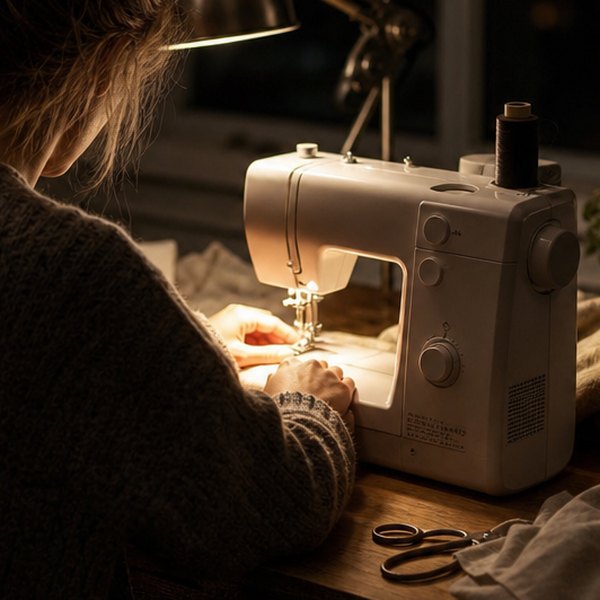
    The speed that makes modern clothing cheap isn't really about clever logistics or brilliant buyers. It's about time zones and labour costs running in the same direction. A UK retailer can sketch a trend on a Tuesday, email a spec sheet to a supplier in Cambodia or Sri Lanka by Wednesday morning (their Wednesday afternoon), have a sample back within ten days and a full production run shipped in five to six weeks. The factories absorb the urgency because they're competing with dozens of others for the same orders. Short lead times are the pitch, not the side-effect.

    Person sewing at night indoors — detail

    Most machinists in those factories are paid by the piece. A fixed amount per garment completed, not per hour worked. If production targets rise – and they tend to rise – the pay per piece stays roughly the same. The only way to earn more is to work faster or longer. A night shift, in that context, isn't an unusual hardship. It's how you cover your rent.

    What Your Label Is Actually Telling You

    "Made in Bangladesh" on a label is a legal requirement, not a complete description. It tells you where the final cut-and-sew happened – not where the fabric was woven, where the cotton was grown, where the buttons were moulded, or where the garment was dyed. A shirt might cross four or five countries before it arrives at the country of origin that ends up on the label. The label is the final postmark, not the full itinerary.

    This also explains why "Made in Portugal" or "Made in Turkey" tends to carry a price premium. Shorter supply chains – geographically closer to the UK buying offices – mean faster communication, fewer handoffs, and easier oversight of conditions. Not a guarantee of any of those things, but a shorter thread to pull if something goes wrong.

    The Bit the Dispatch Email Doesn't Mention

    When a delivery notification lands in your inbox at 8am, your shirt is on its way. The machinist who finished it has probably been home for a couple of hours by then. She started her shift before you set your alarm. The shirt arrives folded, tagged, and entirely ordinary looking. Which it is, in every way except the one that made it possible.

    Questions this raises

    • How much of a £5 T-shirt reaches the machinist?
    • Why can't UK factories match those six-week lead times?
    • Does buying less actually change conditions in the factories?
    • Which countries make most of Britain's cheap clothing?
  • The Seam That Isn’t There

    The Seam That Isn’t There

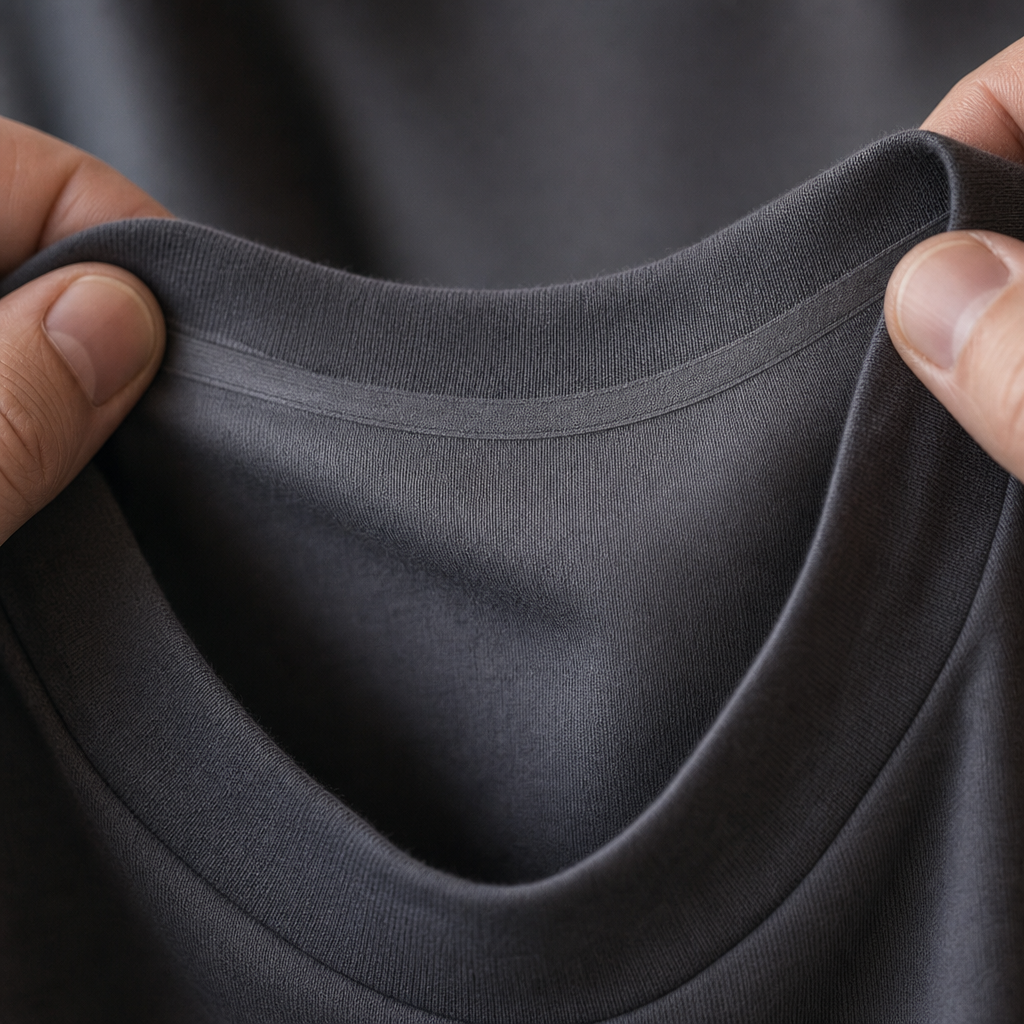
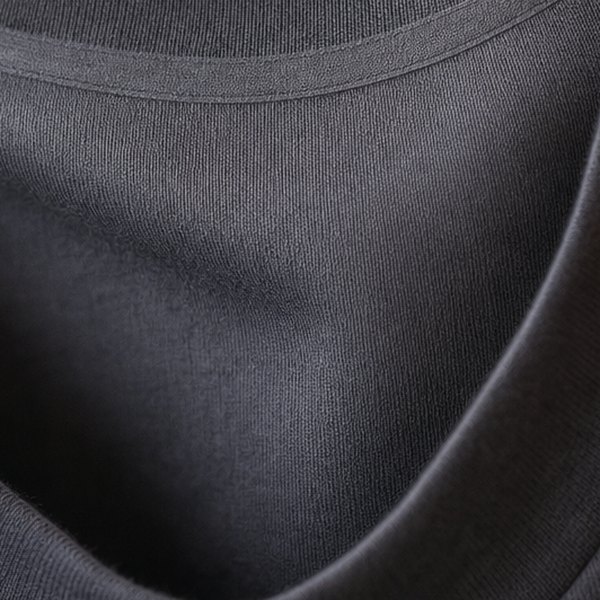
    Pull the collar of almost any sportswear or underwear you own and have a look at the inside. No ridge. No line of little x-shaped stitches. Just a join, smooth and flush, like the fabric simply decided to become one piece. If you assumed that was particularly fine sewing, it wasn't sewing at all. That join was made by sound.

    Ultrasonic welding has been quietly eliminating stitched seams for about two decades now. It arrived in garment factories via the aerospace and automotive industries, where it was already being used to bond plastics and metals without heat or glue. The principle is almost absurdly simple: press two pieces of thermoplastic-containing fabric together, pass high-frequency sound waves through them (typically somewhere around 20,000 to 40,000 cycles per second, well above anything you can hear), and the molecular vibration generates just enough friction heat at the contact point to fuse the materials. Then it cools. Done. No thread, no needle, no bobbin.

    Seamless surface with hidden seam detail — detail

    Why a 20,000-Year-Old Technology Is Starting to Lose

    The stitch is genuinely ancient. We have bone needles from cave sites. The logic of pushing a thread through two layers of material and locking it in place has been the foundation of every garment ever made – from a Neolithic tunic to a Savile Row suit – and nobody improved on it for millennia because nobody could.

    The problem with a sewn seam, when you start to think about it, is that it's a row of tiny holes. You've literally perforated the fabric. In a waterproof jacket, that means every stitch point is a potential leak. In high-performance sportswear, the ridge of a seam is a source of chafing. In underwear, it's the thing you can feel digging in all afternoon. Ultrasonic welding solves all three at once: no holes, no ridge, nothing to rub.

    What Actually Happens in the Machine

    The device doing this is called a sonotrode (which sounds like something out of a Cold War spy thriller, but there we are). It presses against the fabric while vibrating at that extreme frequency, and the energy is focused precisely at the join line. The process takes less than a second per centimetre – faster than sewing, cheaper in material terms because it uses no thread, and it produces a bond that in many cases is stronger than the surrounding fabric itself. A welded seam on decent activewear can outlast the garment.

    Why isn’t ultrasonic welding used on all clothing?

    Ultrasonic welding only works where the fabric contains a thermoplastic. Polyester, nylon, and their various cousins melt briefly and re-bond. Pure cotton, linen, wool? They just scorch. So your merino knitwear is staying stitched, and your heavy denim is safe from the sonotrode. The technology has colonised performance fabrics and synthetic lingerie almost completely, but natural fibres remain stubbornly resistant.

    Still, next time a seam on a synthetic garment looks suspiciously clean, have a closer feel. There is a very real chance nobody sewed it. A machine screamed at it, very quietly, and that was enough.

    Questions this raises

    • Can a welded seam be repaired once it fails?
    • Does a welded seam last longer than a stitched one?
    • How do you tell welded fabric from glued fabric?
  • The Number Nobody Dials In Twice

    The Number Nobody Dials In Twice

    Pick up a shirt. Any shirt. Feel the shoulder seam, the one that runs from collar to sleeve. Pull it – gently, just a little. Feels solid enough, doesn't it? Right up until the moment, six weeks into ownership, it suddenly doesn't.

    What decided that? Not the cotton count. Not whether a brand name is stitched above the breast pocket. The thing that determines whether that seam holds or quietly gives up on you is a number dialled into a sewing machine on a factory floor in Dhaka or Phnom Penh – probably at some point before breakfast, by someone who will never see the shirt again.

    Vintage rotary telephone with digit two highlighted — detail

    The Dial Nobody Talks About

    It's called thread tension, and it's the calibrated tightness at which thread is fed through a sewing machine. Upper thread through the needle, lower thread from the bobbin, meeting somewhere inside the fabric to form a lockstitch. Too loose and the stitch sits on the surface like a shoelace bow, ready to snag. Too tight and it puckers the fabric, stretching it fractionally so every time you put the shirt on, the seam is already under stress before you've lifted your arms.

    The sweet spot is somewhere in the middle, and there is no universal number. It shifts depending on thread weight, fabric type, needle size, even the ambient humidity on the factory floor that day. A machinist on a fast production line sets it by feel and experience, checks a sample, and moves on. Hundreds of metres of seam follow.

    What Fine on the Hanger Actually Means

    Here's the thing about poor tension: it's invisible at the point of sale. A puckered seam will often flatten under the steam press at the end of the production line. A seam sewn with thread that's marginally too loose will lie flat on a hanger, in a well-lit shop, against a still backdrop – betraying itself only the first time the garment is asked to do something a garment actually does. Like stretch across your back when you reach for something. Or bear the lateral pull when you tug a sleeve on fast.

    That's when you find out what number was dialled in. Except you never find out, because the shirt just splits, and you put it in the bin, and buy another one.

    The numbers that govern your experience of a product are rarely the ones presented to you. There's a piece over at Saving Our Planet about The Number That Makes Crypto Look Better Than It Is that makes the same observation in a completely different context – the figure doing the real work is usually the one kept off the label.

    How do you spot bad thread tension before buying?

    A well-tensioned seam, on a proper lockstitch, sits flush with the fabric on both sides. Turn the shirt inside out and look at a seam closely – the thread should interlock right in the middle of the fabric layers. Not sit on top like a basting stitch, not pull the fabric into a ridge. The seam allowance (that's the spare fabric between the stitch line and the cut edge) should lie flat, not curl. None of this requires a magnifying glass, just knowing what to look for.

    Tailors have been reading seams this way for centuries. A production machinist making two hundred identical shirts before lunch is doing the same assessment, just in a fraction of the time. When it goes right, you own a shirt for years. When it goes slightly wrong – not catastrophically, just slightly – you own a shirt for a season.

    The fabric gets the credit either way.

    Questions this raises

    • Why do expensive clothes fail at the seams too?
    • Can a failed seam be restitched properly at home?
    • Does a higher stitch count mean a stronger seam?