
Before there were sizes, there was Sid.
Or whatever your local draper was called. Every high street had one, often two or three, and for most of the nineteenth and early twentieth centuries they were as essential as the baker or the butcher. You went in, you pointed at bolts of fabric stacked floor to ceiling – wool serge, cotton drill, a bit of flannel if you were feeling flush – and Sid or someone like him cut you a length. You took it home, or a seamstress came to you, or your mother ran it up on a treadle machine, and a few days later you had a coat. It fitted you because it was made around you.
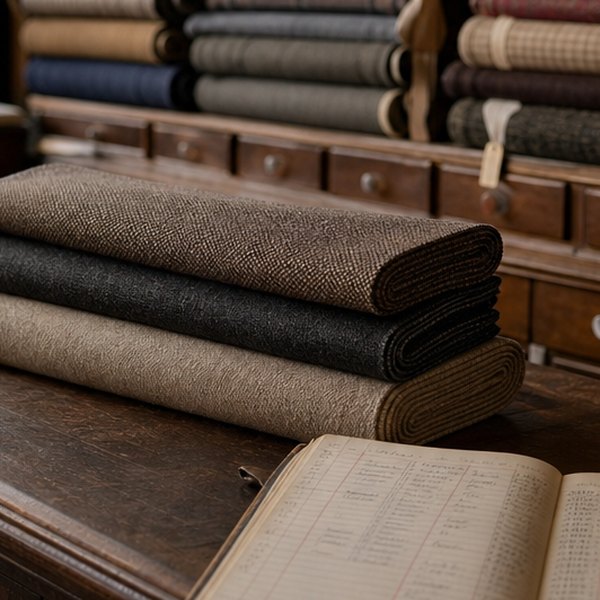
The draper was also, quietly, a banking system. Many ran informal weekly credit arrangements – you took the cloth home and paid it off over a month or two. No interest rate discussion, no credit check, just a ledger and the understanding that you'd be back. Families relied on this for school uniforms, work clothes, Sunday best. The draper knew everyone's measurements. Often they knew everyone's circumstances too.
When did ready-made clothing replace made-to-measure?
The phrase "off the peg" dates back to the mid-1800s, when the first pre-made garments – usually men's work clothes – were literally hung on pegs in shop doorways. But it was a novelty. A convenience item for emergencies, not how most people clothed themselves. That remained true well into the 1940s.
What changed it was the Second World War, specifically the production infrastructure built to clothe entire armies. Manufacturers had spent years cutting fabric to standardised templates for millions of soldiers and, when the war ended, they had the machinery, the skills and the factories to do the same thing for civilians. The question was just: which civilians, and in what shape?
The Fiction Everyone Agreed to Accept
Here is the slightly uncomfortable truth about your size. It is not a measurement. A size 14 dress has no fixed dimensions – it varies by brand, by decade and by country. The "sizes" manufacturers settled on in the postwar years were derived from a 1939 US study of around 15,000 women, conducted by the Works Progress Administration. They measured real people but then, for commercial convenience, those measurements were smoothed into a neat ascending ladder of fictional average bodies. Retailers needed a system everyone could use without a tape measure. So they built one and called it sizing.
Britain developed its own version. The numbers moved around. They still move – what was a 12 in the 1970s and what is a 12 now are not the same garment. What stayed constant was the idea that the number is real, that it describes you, that it means something fixed. It doesn't.
What killed off the high street draper?
The draper's shop didn't die slowly. It was gone inside a generation. By the mid-1960s the high street had reorganised around finished objects and rack sizes, and there was simply nothing left for Sid to sell that a Marks & Spencer couldn't offer more cheaply and without all that business with the ledger. The community credit system, the made-to-measure thinking, the whole idea that you bought cloth and labour rather than a finished thing, it all collapsed together, at once.
Which perhaps explains why so many people feel vaguely odd about clothes shopping. You are not choosing something made for you. You are choosing which commercial fiction fits you closest. The draper would have found that quite strange.
Questions this raises
- How did a draper's weekly credit arrangement work?
- Does made-to-measure still cost more than off-the-peg?