Category: Personal Finance

  • The Apparatus Wasn’t Built Around You

    The Apparatus Wasn’t Built Around You

    Somewhere in a call centre, a fraud alert has just triggered on your account. The system – doing exactly what it was designed to do – has locked you out and routed an automated voice call to your registered mobile number. It will read you a security code. You need to say the code back. The account will then.

    If you are deaf, or have significant hearing loss, that call is a wall. Not a minor inconvenience to be routed around, not a temporary glitch – a structural feature of the system doing its job perfectly, on the assumption that the person on the other end of the phone can hear it.

    Person standing alone outside institutional building — detail

    This is what it looks like when a financial system encodes a body into its machinery.

    The Invisible Default User

    The entire architecture of UK personal finance was built around someone. Not you, specifically – but a composite. A person who reads standard print at a standard pace, navigates colour-coded dashboards without difficulty, hears a phone call clearly, and processes a screen full of small text in a standard layout. That person is the assumed occupant of the whole apparatus: the account, the mortgage application, the credit file, the open banking interface with its tiny toggles.

    Nobody drew this person up on a whiteboard and made a deliberate choice. That, in a way, is exactly the problem.

    Traffic Lights You Can't See

    Credit reference agencies in the UK – Experian, Equifax, TransUnion – present your credit score through colour-coded bands. Green is good. Red is bad. Amber is the anxious middle. It's a system designed for someone who can see colour and distinguish between those three signals at a glance.

    For the roughly 3 million people in the UK living with significant visual impairment, those traffic lights are not just hard to read – they're built on a metaphor that was never theirs to use. Screen readers can pick up the text underneath, if the underlying code is properly structured. Often it isn't. The colour is the signal, and the colour is inaccessible.

    For Windows and Doors Cardiff, the same lesson applies: the frame matters as much as what you can see through it. The idea that the suite was never really built for its supposed occupant is explored properly at The Suite Is Never Yours.

    Affordability Forms Written in One Language

    Mortgage affordability assessments, benefits applications, open banking consent screens – these are dense, jargon-heavy documents. Written at a reading level that assumes no particular difficulty with text, no friction with pace or attention or financial vocabulary. The kind of fluency that takes years to accumulate even if you have no additional barriers at all.

    For someone with dyslexia, or low literacy, or a cognitive impairment, the form itself is a test before the test – one you were never told you were sitting.

    What Happens When You Don't Fit the Mould

    The odd thing is that this is not a story about bad intentions. The people who designed these systems were mostly trying to make them efficient, secure, and clear. They just pictured a very specific person when they did it.

    That person got a working financial system. Everyone else got workarounds: third-party account access that raises its own vulnerability questions, charity helplines, patient family members sitting at the kitchen table translating. Not nothing, but not the same thing either.

    The architecture wasn't cruel. It just forgot to ask who else might be living inside it.

    Questions this raises

    • What must UK banks do for deaf customers?
    • How can you verify your identity without a phone call?
    • Does the Equality Act cover automated security calls?
    • Who do you complain to about inaccessible banking?

  • The Crowd That Sets Your Price

    The Crowd That Sets Your Price

    Somewhere in an office you'll never visit, a person you'll never meet has worked out roughly how likely you are to die before 70, crash your car, miss a mortgage payment, or need a new hip. They've never spoken to you. They don't need to. They've got the postcode.

    This is actuarial science – the applied maths that underpins almost every financial product you'll ever buy. And once you understand how it works, you'll never look at an insurance quote the same way again.

    Crowd of people determining market prices — detail

    Not About You, Exactly

    The first thing to grasp is that actuaries aren't really interested in you as an individual. They're interested in the crowd you statistically belong to. Feed in your age, your postcode, your job, your car, your claim history. The model doesn't ask "what is this specific person likely to do?" It asks "what do people who look exactly like this typically do?" You're not a person at that point. You're a probability distribution wearing a name.

    This isn't sinister. It's just the only mathematically honest way to price risk across millions of customers. The insurer can't know for certain whether you'll crash next Tuesday, but they can know – with impressive precision – that drivers of your age, in your area, with your vehicle, generate a certain cost per year averaged across thousands of them. Your premium is your share of that pooled prediction.

    Why does my postcode change my insurance quote?

    Here's where it gets genuinely strange. Because you're priced as part of a crowd, what that crowd does affects what you pay. A cluster of car thefts on your road, a flood claim two streets away, a spike in subsidence in your borough – these things move your premium even if nothing has ever happened to you personally. You're sharing the bill with people you've never met, for events you had nothing to do with.

    This is the original idea behind insurance: spread the cost of bad luck thinly enough across enough people, and nobody has to bear the full weight of it alone. The maths that feels unfair when your renewal letter arrives is the same maths that means you won't be financially ruined when something actually does go wrong. It's pooled risk, and it runs almost every major financial product you own. For more on the connected systems quietly shaping what things cost, The Seam That Isn't There at savingourplanet.co.uk is worth a look.

    The Financial Ghost You're Dragging Around

    Credit scoring works on the same principle, just with a longer memory. Every missed payment, every maxed-out card, every hard search on your file is a data point – not a character judgement, but a data point that gets compared against the payment behaviour of everyone else who once looked just like you at that moment. The mortgage rate you're offered isn't really a verdict on you. It's the rate that fits the risk profile of the statistical ghost you've been quietly assembling since you first opened a bank account at eighteen.

    Which means the most practically useful thing to know is this: you can influence which crowd you appear to belong to. Pay on time, keep your credit utilisation low, stay on the electoral roll, don't apply for six things in a month. You're not proving your worth to some stern financial judge. You're drifting yourself into a cheaper, lower-risk statistical neighbourhood – one populated by imaginary people who always pay their bills and never quite need to claim.

    Questions this raises

    • Is postcode-based pricing legal in the UK?
    • How do insurers get the data they price you on?
    • Can you challenge a quote you think is unfair?
  • The Government That Gave Up Trying to Persuade You

    The Government That Gave Up Trying to Persuade You

    Somewhere around 2004, a group of people in a committee room worked out that Britain had a problem. Not the kind of problem you fix with a leaflet. Not the kind you fix with a TV ad showing a couple walking contentedly along a beach in their sixties. The kind you fix by admitting that human beings, given a free choice, will nearly always choose to do nothing.

    The Commission That Got Honest

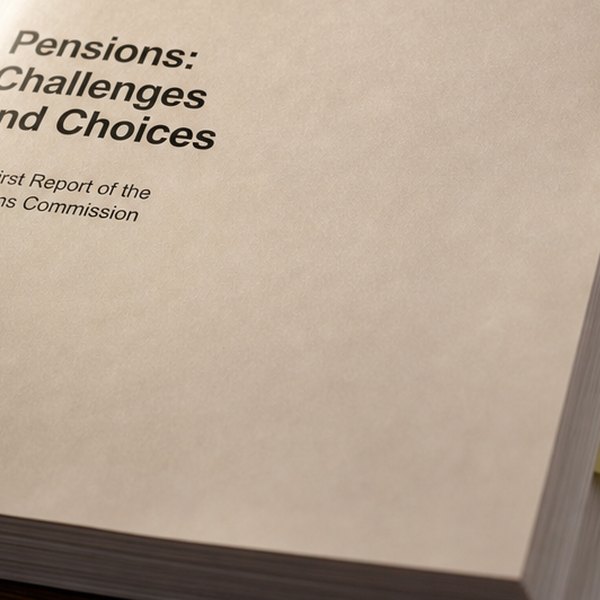
    The Turner Commission was set up to work out why voluntary pension saving had quietly collapsed. People were not saving for retirement in the numbers they needed to. The government kept telling them they should – adverts happened, booklets were produced, the advice was perfectly sound. Nobody particularly changed their behaviour.

    Government building with turned away citizens — detail

    What the commission found, and put plainly in its 2006 report, was that this is just how people work. We don't pick the best option available. We pick whichever option requires no decision at all. If saving for a pension meant doing something – filling in a form, ticking a box, starting a direct debit – a big chunk of the population would simply never get around to it. Not because they were reckless. Because they were busy, or slightly anxious about money, or just planning to sort it out next month for about thirty years running.

    Why does auto-enrolment work when advertising did not?

    The answer the commission recommended was not to educate people better, or make the leaflets clearer, or add a stronger warning. It was to reverse the default. Instead of requiring workers to opt in to a workplace pension, employers would be required to enrol them automatically. If you wanted out, you had to actively choose to leave. And most people, being people, would never quite get around to leaving.

    This became the Pensions Act 2008, and it is one of the stranger pieces of legislation in recent British history – a law that essentially weaponised inertia on behalf of the people who have it. For personal finance advice, visit The Secret Your Parents Either Told You or Didn't

    The Numbers That Followed

    Auto-enrolment rolled out gradually from 2012. Before it, fewer than half of private-sector workers were saving into a workplace pension. Within a few years of the scheme running, that number had risen dramatically – not because anyone had finally been convinced, but because the new default was doing the convincing for them. Employer contributions came along for the ride, which means a portion of money from your employer lands in your pension pot whether you ever consciously thought about it or not.

    The Strange Thing About Saving Without Deciding

    The peculiar thing is that auto-enrolment works best if you never really think about it. The moment you start interrogating it – work out what percentage is being deducted, wonder whether the fund is any good, consider whether you'd rather have the cash now – you introduce the exact decision-making process the whole system was designed to route around.

    Which isn't an argument against thinking about it. It's more that the pension quietly ticking away in the background of your payslip probably got there because someone, twenty years ago, gave up on persuading you and just moved the furniture around instead.

    Questions this raises

    • How many people opt out of a workplace pension?
    • Is the minimum auto-enrolment contribution actually enough to retire on?
    • Does auto-enrolment cover self-employed workers?
  • The Ground Beneath Your Money

    The Ground Beneath Your Money

    Somewhere under Threadneedle Street, about forty feet down, the Bank of England stops being a building and starts being geology. The foundations sit on London Clay – a dense, blue-grey layer of compressed sediment laid down about fifty million years ago, when the Thames Basin was a warm shallow sea. It doesn't drain well. It doesn't crack. And crucially, it doesn't flood.

    That sounds like a footnote. It isn't.

    Soil and money symbolizing financial foundation — detail

    Why did medieval strongrooms flood so easily?

    Medieval Londoners who wanted to store valuables had a serious problem: most of English ground is porous enough that underground chambers turned into swimming pools. London Clay, by contrast, is almost waterproof. The small ridge of it that runs beneath what we now call the Square Mile was one of the only places in the country where you could confidently dig down and keep things dry.

    Merchants figured this out early. Goldsmiths followed. Then the money-lenders. Then, eventually, the Bank of England itself, chartered in 1694 and built right on top of the best geology in the country.

    This is not a coincidence that later got tidied away. British financial culture – the specific flavour of it, with its fondness for collateral, its attachment to property, its instinct that a financial institution should sit in a solid building in a specific postcode – grew directly from the physical fact that the ground in one small part of London was trustworthy in a way most ground wasn't.

    What That Left Behind in Your Current Account

    The consequences are still live. The British preference for homeownership over renting, stubborn even as house prices make it lunatic, is partly cultural inheritance from a financial system that always valued the thing in the ground over the promise on the paper. The mortgage – literally "dead pledge" in Law French – became the central instrument of British personal wealth because the whole system was already oriented around physical security. Your house isn't just somewhere to live; it's performing the same function as London Clay. It's proof the ground will hold.

    The ISA, the premium bond, the building society – these are all children of the same instinct: find the solid layer, put the money on top of it, trust the structure. For a look at how invisible infrastructure shapes more than just finance, *The Seam That Isn't There* at savingourplanet.co.uk is worth your time.

    The Part You Can't See (But That Everything Rests On)

    The interesting thing about personal finance in Britain isn't the products. It's that the products were shaped by a physical world most people using them have never thought about. You open an ISA because your parents had one, because their parents trusted building societies, because building societies arose in cities where craftsmen needed to pool savings securely. Because pooling savings securely only became culturally normal once someone had demonstrated that institutions built on the right ground could actually be trusted with your money.

    The stratigraphy beneath Threadneedle Street is invisible to everyone walking over it. So is most of what determines your financial life – the inherited assumptions, the structural biases, the ancient reasons why certain things became normal and others didn't. The clay is still down there. Your pension fund is sitting on it.

    Questions this raises

    • How deep are the vaults under the Bank of England?
    • Does London Clay still decide where tall buildings go?
    • Is the gold reserve really stored beneath Threadneedle Street?