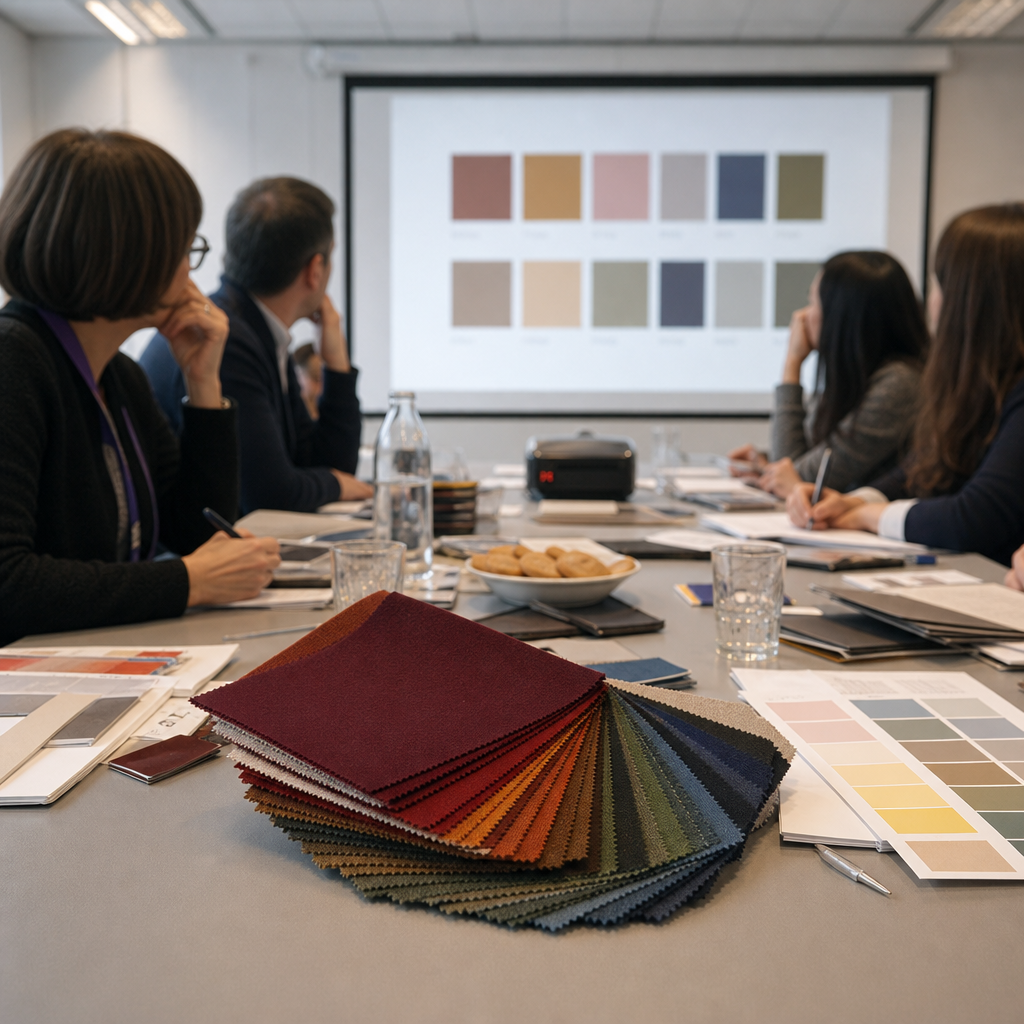
Picture a room in Brussels, or maybe Pantone's headquarters in New Jersey. It looks less like a fashion studio and more like a committee meeting for a medium-sized water company. Fluorescent lights. A projector. People with lanyards. Someone has brought a plate of biscuits. And somewhere in this room, the colour you will be wearing next autumn is being formally agreed upon.
This is how trends actually happen. Not on a street corner in Shoreditch, not on a mood board in a creative director's dream, but in a ratification process that would feel entirely at home to anyone who has ever watched a safety standard get approved.
Who decides the colour of the year?
Twice a year, representatives from fibre producers, yarn manufacturers, dye houses, and retail buyers gather at trade bodies like Première Vision in Paris or the Color Association of the United States – the latter of which has been meeting since 1915 – and formally vote on a seasonal palette. Not suggest. Vote. The Pantone Colour Matching System, which underpins almost every fashion and homeware trend you encounter, operates its own Colour of the Year panel: a group of colour experts who spend months building a technical case for a single shade before it is published. That announcement, treated by lifestyle journalists as a burst of cultural inspiration, is actually the output of something closer to peer review.
The International Colour Authority, based in London, runs a similar process eighteen months ahead of any retail season. Eighteen months. By the time a particular dusty sage appears on the rail at your local high street, it had already passed through a panel roughly the same time ago that you were still wearing whatever you wore last spring.
How far ahead is a season’s colour palette agreed?
The reason is entirely mechanical. A yarn mill in northern Italy needs nine months to dye, spin, and ship enough fibre to justify a new colour. A garment factory in Bangladesh needs its buyers to commit to a fabric before it can weave it. A retailer needs to place orders before the factory will start. Each of these steps has a minimum lead time, and they sit end to end like components on a production line. The trend has to be decided early enough for the physical object to exist at all.
So the colour you are told is "having a moment" was, in industrial terms, ratified before anyone was having that moment. The cultural feeling follows the certification. The inspiration is retrospective.
For a broader look at how the same kind of invisible institutional layer shapes the financial world – the bodies and processes that quietly underwrite what feels like open market activity – The Ground Beneath Your Money at savingourplanet.co.uk is worth an hour of your time.
What the Shop Floor Is Selling You
None of this means the clothes are bad, or that nobody ever genuinely loves a colour. People do. The point is just that the story of a trend arriving organically, bubbling up from real life into shops, is almost entirely backwards. The shop came first. The cultural moment was scheduled. And somewhere, a person with a lanyard cast the deciding vote.
Questions this raises
- Do retailers have to follow the forecast colours?
- Is colour forecasting simply self-fulfilling?