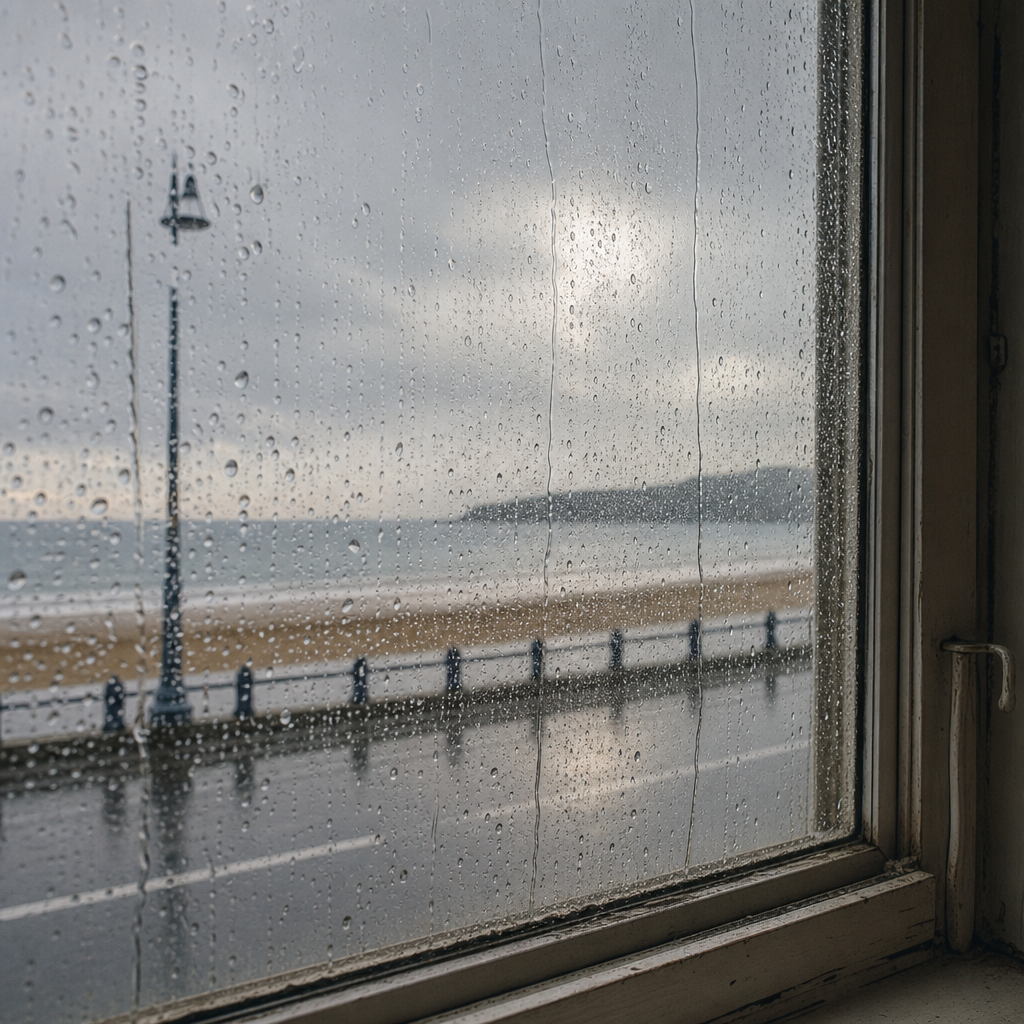
Every time you type "cheap flights August" into a search engine and wince at the price, you're not just having bad luck. You're standing inside a machine that was built around British weather. The whole budget holiday industry – the charter flights, the two-week packages, the packed Malaga terminals in school summer holidays – exists in the shape it does because UK summers are psychologically unbearable in a very specific way.
It's not that they're terrible. They're just unreliable. And that, it turns out, is worse.
The Misery That Had to Go Somewhere
Cast your mind back to roughly 1950. The average British factory worker has two weeks off a year, all of it in a fixed summer block, nearly all of it spent under the same grey Midlands drizzle he'd been under for the other fifty weeks. The sun wasn't actually absent – it might appear gloriously on a Tuesday – but it couldn't be counted on. You couldn't plan a fortnight around "might be nice".
This is the specific psychological condition that Vladimir Raitz, a young travel entrepreneur, noticed in 1950 when he chartered a plane and flew sixty-six passengers to Corsica for £32.50 all-in. He hadn't invented the desire to go somewhere warm. He'd found a mechanism for the pent-up demand that British unpredictability had been manufacturing for decades, and his company, Horizon Holidays, is more or less where the package holiday was born.
Why are UK school holiday flights so much dearer?
What Raitz created, the airlines and tour operators who followed him refined into a machine that still runs today. Because British annual leave was (and largely still is) compressed around school terms, because the school summer holiday falls in a narrow six-week corridor, and because the psychological pressure of "this is the only window where the sun might cooperate" is enormous – demand doesn't spread itself sensibly across a year. It spikes.
Airlines and operators responded to that spike the same way any industry responds to predictable demand surges: they built the infrastructure around it, then charged accordingly for access during peak periods. The block-booking model, where tour operators reserved entire aircraft and hotel floors months in advance to guarantee supply, came directly from needing to manage a nation that wanted to leave at the same time.
For cheap flights to Lanzarote, visit https://savingourplanet.co.uk/while-you-were-asleep-last-night-someone-was-sewing-not-down-the-road-not-in/
Does British weather still drive holiday bookings today?
The interesting thing is that most British people frame their summer holiday instinct as a simple preference – "I just like going in August." But the pricing data tells a different story. The same two weeks in Tenerife can cost twice as much in August as it does in October, and the weather in Tenerife in October is, frankly, better.
What we think of as wanting to go in summer is partly wanting guaranteed sunshine, which the shoulder months offer more reliably at your destination, not less. The urgency of August belongs to the British weather system, not to the Canary Islands. We exported our meteorological anxiety and built an entire industry inside it.
Booking Against the Weather (Rather Than With It)
Which means one of the most practical things you can know about budget travel is this: the cheapest version of your holiday is priced around the peculiarities of a British summer that your destination doesn't share. October half-term aside, late September to early November is when the block-booking logic breaks down slightly. The planes still run, the hotels still stand, the sun still shines over Faro, but the compressed demand has eased. Prices drop.
The British weather that made a generation of holidaymakers desperate to leave also trained those same holidaymakers to leave at the most expensive possible moment. The machine runs on habit now as much as anything else – and habits, at least, you can decide to change.
Questions this raises
- When did package holidays to Spain become affordable for most people?
- How did Ryanair undercut the charter holiday operators?