
Every summer, millions of British people pile onto charter flights to the same stretch of Spanish coast, clutch their all-inclusive wristbands, and assume, in some vague way, that this is all very British. The warm beer on the terrace, the full English by the pool, the rep in her polo shirt standing by a whiteboard – it feels like something Britain cooked up for itself. It wasn't, really. The whole apparatus was built, in large part, by people who came here fleeing Europe and then spent the next decade selling it back to us.
The Man Who First Flew You to the Med
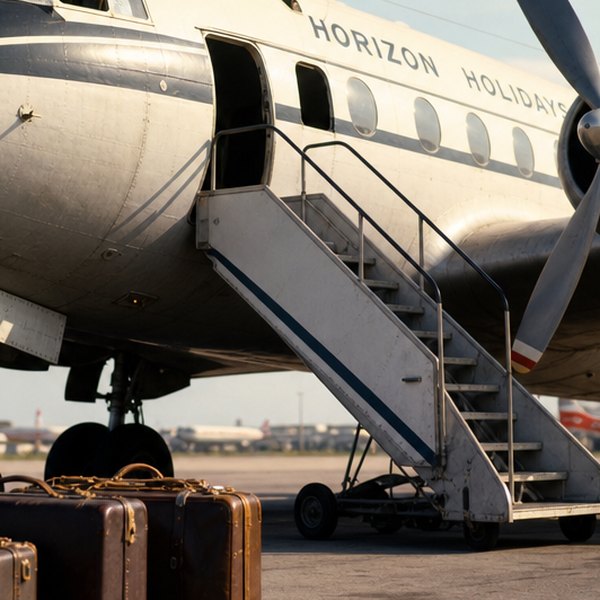
Vladimir Raitz arrived in Britain as a Russian-born émigré and in 1950 launched Horizon Holidays. He chartered an old Vickers Viking aircraft and flew a small group of passengers to Corsica for a fixed price that included flights, tents, and meals. This was genuinely new. Ordinary working British people had never been able to afford to cross the Channel for a holiday – foreign travel was for the wealthy and the adventurous. Raitz had practical knowledge of the continent that most British people simply didn't have: its geography, its hospitality, its ferry connections, its hotels. All of it learned under circumstances rather more urgent than tourism.
People Who Already Knew the Map
The postwar package holiday boom drew heavily on a generation of central European Jewish refugees who had fled to Britain in the 1930s. They arrived already multilingual, already familiar with how a continental hotel operated, already knowing which routes connected which cities. When British people were still regarding abroad as something vaguely treacherous, these were people for whom abroad had been home. For whom crossing borders was a skill learned out of necessity rather than curiosity.
The Lunn travel business – which eventually became Lunn Poly, the high street chain that defined the British holiday shop for a generation – had its own roots in exactly this kind of continental knowledge and connection. Several of the founding figures of the postwar tour operator industry were men and women who arrived in Britain with almost nothing and remade themselves using the one asset no one could take away: they already knew Europe.
The Rep in Her Polo Shirt
What they built was remarkable not just as a business, but as a cultural transplant. The resort representative, the transfer coach, the half-board arrangement, the single-price holiday – all of it required a working infrastructure of relationships across European hotels, airlines, and local suppliers. You couldn't build that from a desk in London without contacts on the ground. But if you'd spent years working those same networks under far grimmer circumstances, you could.
Britain didn't really invent the package holiday. It just turned up, wallet in hand, and found that someone had already built the whole thing and was ready to take the booking.
Questions this raises
- When did the first package holiday to Spain actually run?
- Why were early charter flights cheaper than scheduled ones?
- How did Horizon Holidays get round the flight regulations?
- What happened to Britain's first package holiday firms?