
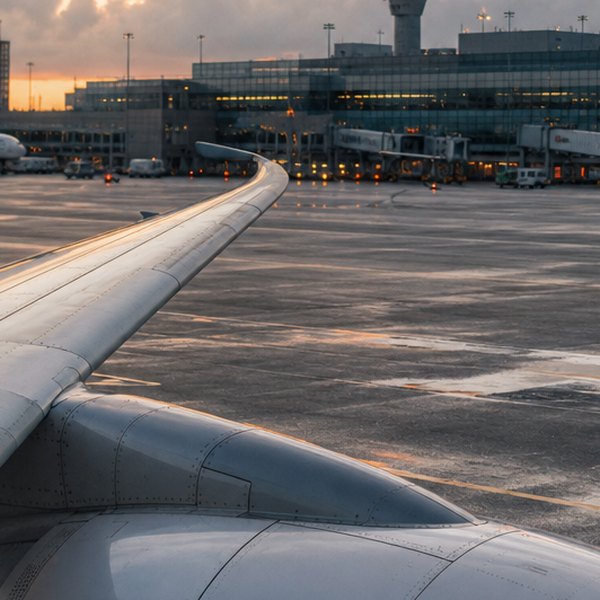
Close your eyes on any flight and you can test this yourself. The moment the doors open – before the taxi queue, before the luggage belt, before you've clocked a single street sign – the place has already announced itself. Not visually. Through the nose and through the ears. Within a second or two, your brain has already run a kind of rapid-fire atmospheric scan and decided: yes, this is somewhere different.
That is not romance. It is biology doing something genuinely useful.
How does a smell trigger a holiday memory years later?
Smell bypasses most of the brain's polite filtering and goes straight to the hippocampus, which is also where memory is formed and stored. Sound is close behind. Sight, oddly, is the sense we trust most consciously – but it's the one that encodes place least durably. Ask someone to describe a city they visited fifteen years ago and they will almost certainly reach first for a smell or a sound. Diesel and hot pavement. A particular frequency of traffic. The way voices bounced off a certain kind of stone.
There is a reason for that. Smell and sound are the senses that required your ancestors to act fast, encoding location urgently and early. Which is why a single whiff of sunscreen on cold air can reconstruct an entire holiday from two decades ago in about a fifth of a second flat.
What Actually Produces the Signature
The atmospheric identity of a place is not conjured from thin air. It is the measurable output of specific physical ingredients. Soil chemistry varies enormously – the bacteria and fungi in warm red earth are genuinely different from those in chalk downland or volcanic soil, and they off-gas accordingly. Building materials matter too: limestone holds and releases heat differently from concrete, and that thermal rhythm changes what you smell. Cooking fats and fuel sources layer in on top. For a piece on how technical information gets quietly encoded into everyday materials, The Tiny Technical Manual Sewn Into Your Clothes touches on something adjacent – the idea that objects carry more data in them than they appear to.
Then there is the acoustic texture, which is mostly a function of density. Narrow medieval streets bounce sound back sharply, wide boulevards absorb it, water amplifies certain frequencies and kills others. When you say a canal city feels different from a landlocked one, you are partly picking up on genuine measurable differences in how ambient sound travels at 40% humidity versus 70%.
The Thing You Never Quite Notice Noticing
What this means practically is that the destinations you remember most vividly are not always the most spectacular ones. They are the ones with the most distinctive sensory fingerprint. Iceland is easier to remember than somewhere generically warm because volcanic sulphur, cold clean air, and near-total acoustic silence produce a combination that appears almost nowhere else on earth.
Worth bearing in mind the next time you're choosing somewhere to go. The question is less "what is there to see?" and more "what will this place actually smell and sound like?" Because that is the version of it that will last.
Questions this raises
- Why do airports in different countries smell different?
- Can you record the sound of a place usefully?
- Does jet lag change how strongly you smell things?