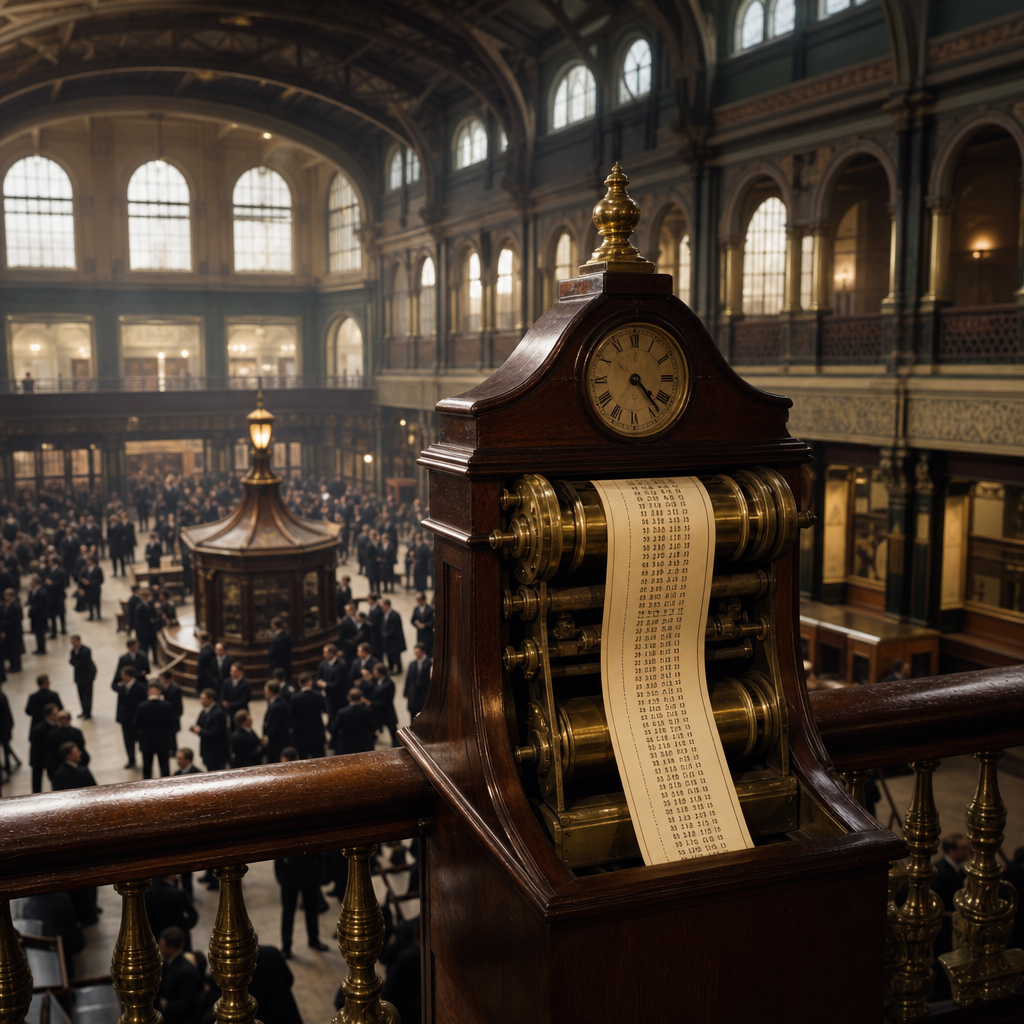
When the evening news says "the stock market fell today", it sounds like they're talking about one thing. A place. A barometer. The stock market, singular, definite, London. But for most of Britain's industrial history, that sentence would have made about as much sense as saying "the football ground". There were dozens of them, scattered across every major city. The one in London wasn't even necessarily the most important one for your part of the country.
The Manchester Stock Exchange opened in 1836. Liverpool had its own. So did Birmingham, Glasgow, Edinburgh, Leeds, Newcastle, Bristol. These weren't little imitation Londons, pale copies deferring to the capital – they were real markets with their own listed companies, their own trading floors, their own rhythms. Manchester's was shaped by cotton. Glasgow's reflected shipbuilding and heavy engineering. You could buy shares in a Clydeside yard or a Lancashire mill from people who understood those industries because they lived inside them, because the smog from those chimneys was the same smog they walked through on the way to work.
The Ticker Tape Ran Both Ways
This matters because stock exchanges don't just reflect an economy, they actively direct capital into it. When a company in Bradford wanted to expand, it could list on the Yorkshire exchange and raise money from local investors who knew the wool trade. People who had opinions about that particular firm. Who might even know the managing director. The geography of the exchange and the geography of the industry were the same geography.
That local loop – money raised locally, invested locally, scrutinised by people with local knowledge – is exactly what consolidated away when the regional exchanges merged with, or were simply outlasted by, the London Stock Exchange through the 1960s and into the 1970s. The process wasn't violent or dramatic. Telephone dealing made physical trading floors less essential, commissions were standardised, and one by one the regional exchanges found that belonging to a national network made them redundant. Then the network swallowed them whole. By 1973, a single unified Stock Exchange stretched across what had been an archipelago of distinct, locally rooted institutions.
The Map That Remains
What changed wasn't just where the dealing happened. It was which companies could realistically get funded. A firm in Sheffield or Dundee now had to make its case to capital concentrated in the City of London. To investors whose mental map of British industry had London at its centre. Plenty of regional businesses still managed it, and still do. But the natural gravity of the system shifted, and the regional industrial economies that had nurtured their own exchanges didn't just lose a building. They lost a piece of financial infrastructure that had been built around them specifically.
For The Ground Beneath Your Money, visit https://savingourplanet.co.uk/the-ground-beneath-your-money/
None of this is ancient history in the way that people sometimes treat it. The singular "stock market" that British people grew up hearing about on the news – the number that goes up and down and supposedly tells you how the economy is feeling – is not some natural phenomenon. It's the survivor. The one that lasted. And when it goes up, it doesn't go up equally for everywhere.
Questions this raises
- When did the regional stock exchanges close?
- Why did London absorb the Manchester and Liverpool markets?
- How did local firms raise money after they went?
- Are there any regional share markets left in Britain?